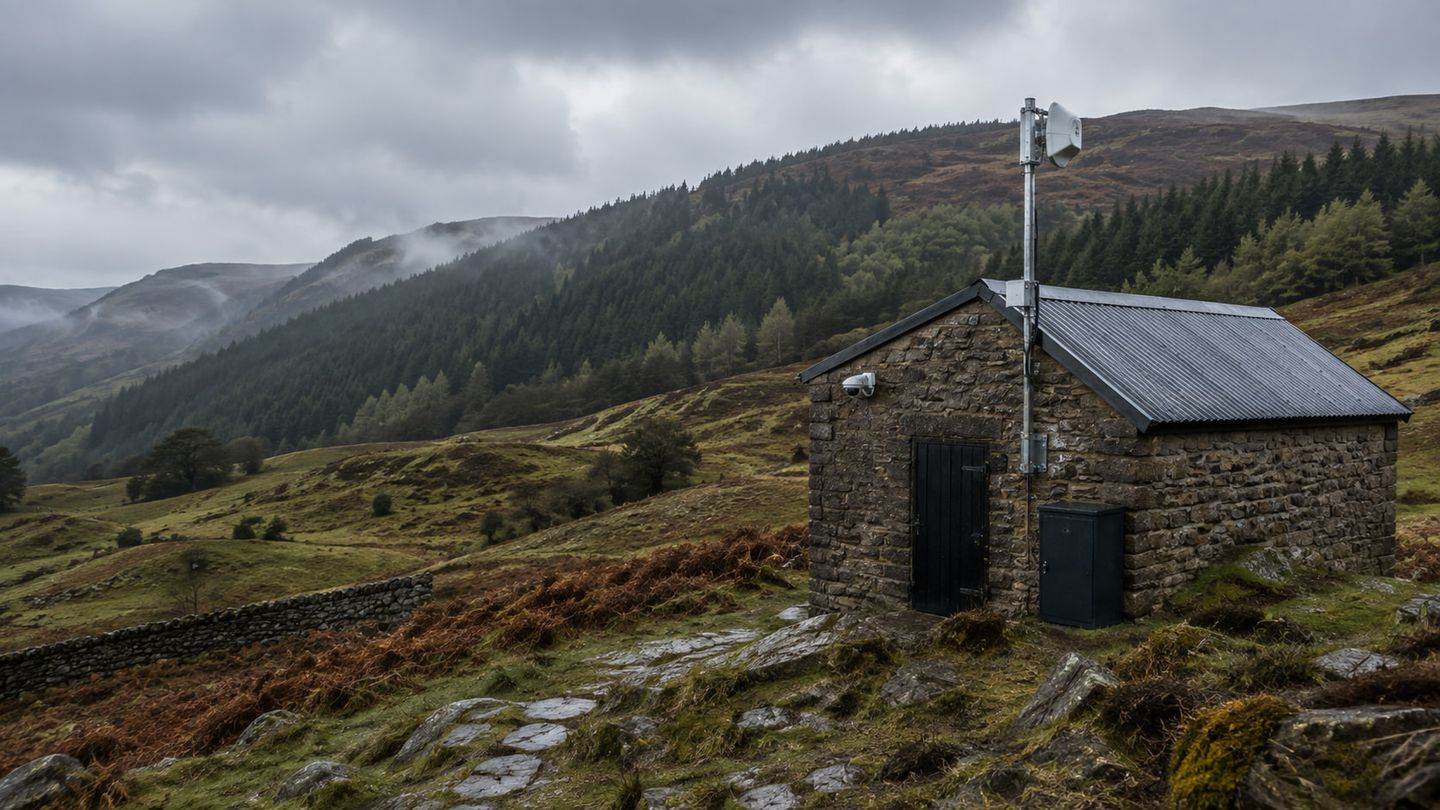
Remote monitoring
Remote monitoring, connectivity and power
On most rural sites the cameras are the easy part. The hard part is getting a picture back from a building with no broadband, no signal and no spare power, and getting a response when something happens at three in the morning.
This is the part of a rural quote that separates people who work on farms and yards from people who work in towns and have been asked to do one. Structured cabling, networking and telecoms are core capabilities here, which is why connectivity gets designed alongside the security rather than discovered on the day of installation.
Every survey checks three things at every building we plan to cover: what power is available, what the broadband actually does there, and what the mobile signal actually does there. Not what it does at the farmhouse.
Getting the signal back
Four answers, in the order we try them.
A cable, where a cable is sensible
If there is an existing duct, a hedge line that can be trenched, or a building within a normal cable run, wire it. A buried fibre or copper link is the most reliable option and it does not care about weather, trees or a neighbour building a barn in the line of sight.
A point-to-point wireless link, where it is not
Licence-free radio carrying a distant building back to the recorder over line of sight, at distances that cover most holdings. Usually far cheaper than trenching across a yard or under a track, and quick to install. It needs a clear path, so we check for the tree in the way at survey rather than afterwards.
4G, where there is no fixed line worth using
A router with an external aerial mounted where the signal actually is, which is often not where the equipment is. We measure at the building during the survey rather than trusting a coverage map, because rural coverage maps and rural reality are different documents.
Nothing at all, where that is the honest answer
Some buildings cannot be usefully connected without spending more than the contents are worth. In those cases local recording with a visit to collect footage, or simply not covering that building, is the right recommendation. We would rather say so than sell a link that will not hold.
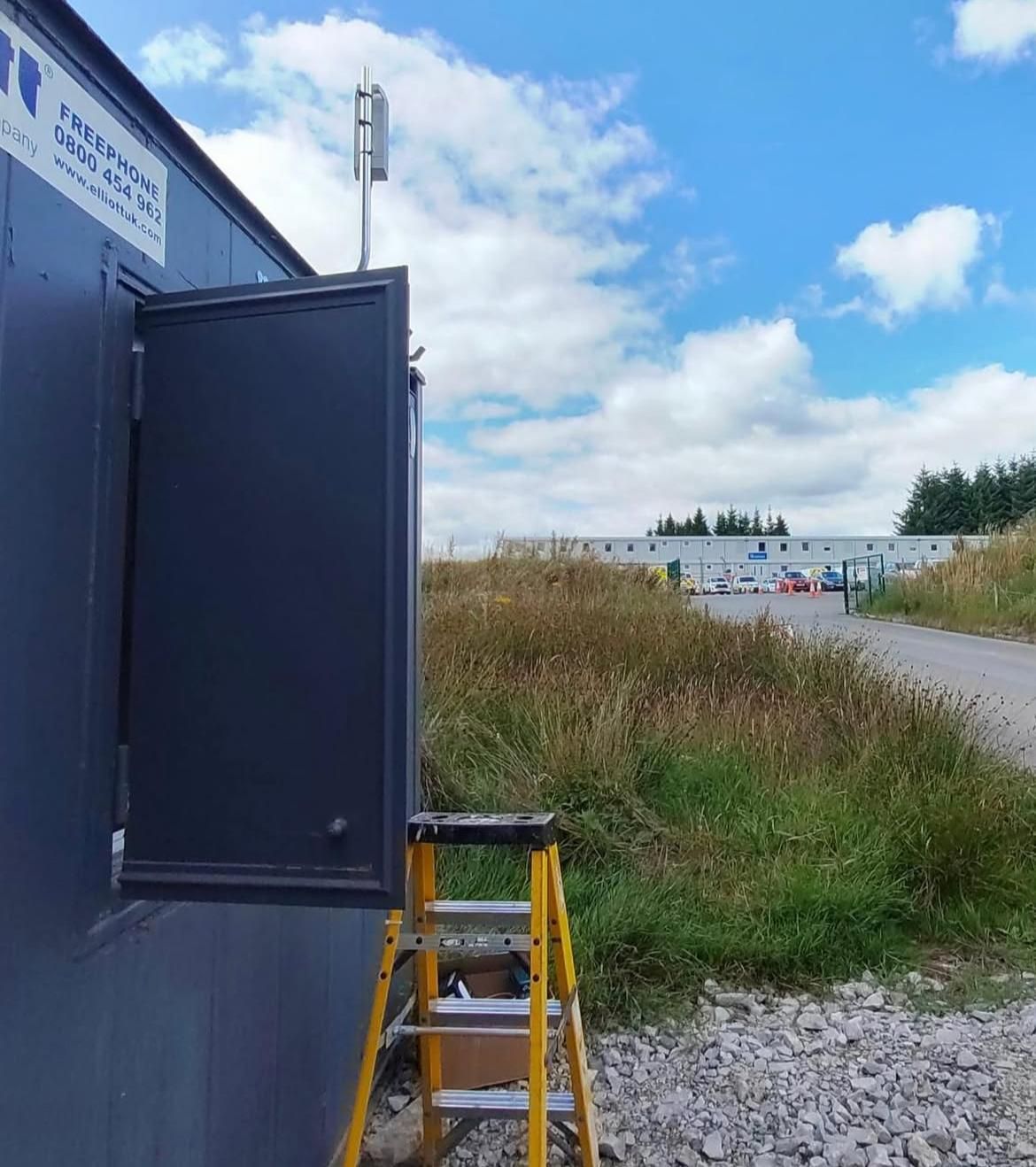
Power, where there is none
Mains, extended properly
Where a supply exists within reach, running an armoured spur to a building is usually the cheapest long-term answer. Solar looks cheaper until the third winter.
Solar and battery, with honest arithmetic
Standalone units cover a gateway, a field entrance or a stack where a supply is not worth running. They work, within limits. A Welsh December gives very little usable light, so panel size, battery capacity and how hard the camera works get calculated rather than guessed, and we will tell you if the numbers do not add up for your position.
Standby for the things that must not stop
Alarm panels and recorders run on batteries sized for a defined outage. Rural supplies drop more often than urban ones, so standby duration is specified rather than assumed, and signalling is chosen so a power cut is not a silent gap in cover.
And then, who responds.
To your phone
Alerts and remote viewing to the people who should have them. It suits most yards and farms, and it works as long as the alerts stay rare enough to still be read. Tuning that is part of commissioning, not a setting you are left to fight with.
To a monitoring centre
Where the risk justifies it, activations go to an alarm receiving centre that can verify against the cameras and escalate to a keyholder or, for a suitably graded and certificated system, to police response. It carries an ongoing cost and a set of rules about false activations, and it is not right for every site.
To nobody, at three in the morning
Worth saying plainly. A system whose only response is a siren on a building three hundred metres from the nearest person is not a monitored system. If that is what a quote is offering, it is worth knowing before you buy it.
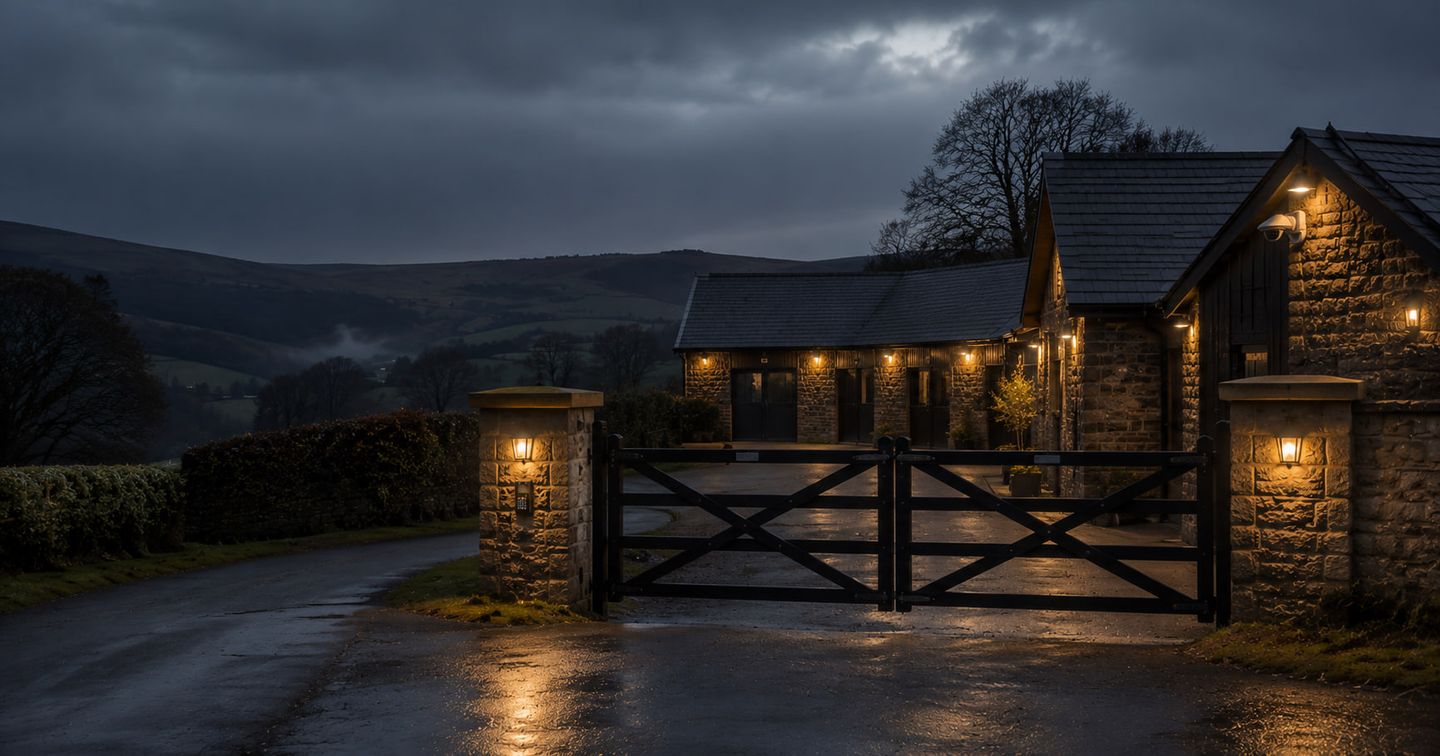
The building at the end of the track
Distance is a networking problem before it is a camera problem.
Explore CCTVIn practice
Getting a signal, and getting a response.
Two separate problems. One is carrying a picture back from a building that has nothing. The other is making sure something happens when it shows you an intruder at three in the morning.
On an equestrian yard
Foaling and welfare views on a phone from the house, and yard cameras reachable when the yard is empty. Where the stable block is out of reach of the router, a link from the house carries it back rather than a trench across the arena.
View equestrian securityOn a working farm
Point-to-point links to sheds a field away, 4G where there is no fixed line worth using, and solar and battery on a gateway with no supply. Signal is measured at the building during the survey rather than read off a coverage map.
View farm securityOn a rural estate
Multiple buildings on one network with viewing separated by who should see what, and alerts routed to whoever is genuinely able to act at that hour rather than to a single phone on a bedside table.
View rural estates
Questions we get asked
We have no broadband at all. Can we still have cameras?
Yes. Cameras record locally to a recorder on site whether or not there is any connection. A connection is what gives you remote viewing and alerts, and where there is no fixed line that is normally 4G with the aerial positioned properly.
How far will a wireless link go?
Far enough for almost any holding, given clear line of sight. The limit in practice is rarely distance, it is what is in the way: a barn, a rise in the ground, or a line of conifers that will be four metres taller in five years. That is a survey question.
Will cameras use up a mobile data allowance?
Continuous streaming would. Systems are set up so that recording happens locally and only alerts and the clips you actually open cross the mobile connection. We size the data plan for how you intend to use it.
Do solar cameras work through a Welsh winter?
Some do, in the right position, doing a modest amount of work. Many do not. It depends on panel size, battery capacity, how much the camera records and whether the position gets any December sun at all. We would rather do that arithmetic with you than have you buy one twice.
Can you monitor a system you did not install?
Sometimes, depending on the equipment and its condition. We would need to survey it and, in most cases, take on its maintenance, because nobody can sensibly respond to a system they cannot service.
Related systems
What monitoring usually sits alongside
Most sites end up with two or three of these working together. Each has its own page.
CCTV
Cameras that read a number plate at the gate and a person at the barn door, in the dark, in the rain.
Intruder alarms
Detection zoned around tack rooms, workshops and fuel stores, set up so livestock and weather do not trip it.
Access control & gates
Entry that survives twenty liveries, a farrier, a vet and a feed delivery, without a key under the water trough.
Fire detection
Early warning in stable blocks, hay and straw stores and workshops, where a fire is unsurvivable within minutes.
Servicing & maintenance
Lens cleaning, seal checks, battery replacement and signal tests, because rural kit weathers faster.
Next step
Find out what your site can actually carry
The survey measures power, broadband and mobile signal at each building we would cover, not at the house. You get a connectivity plan alongside the security specification, and an honest note on anything that will not work.