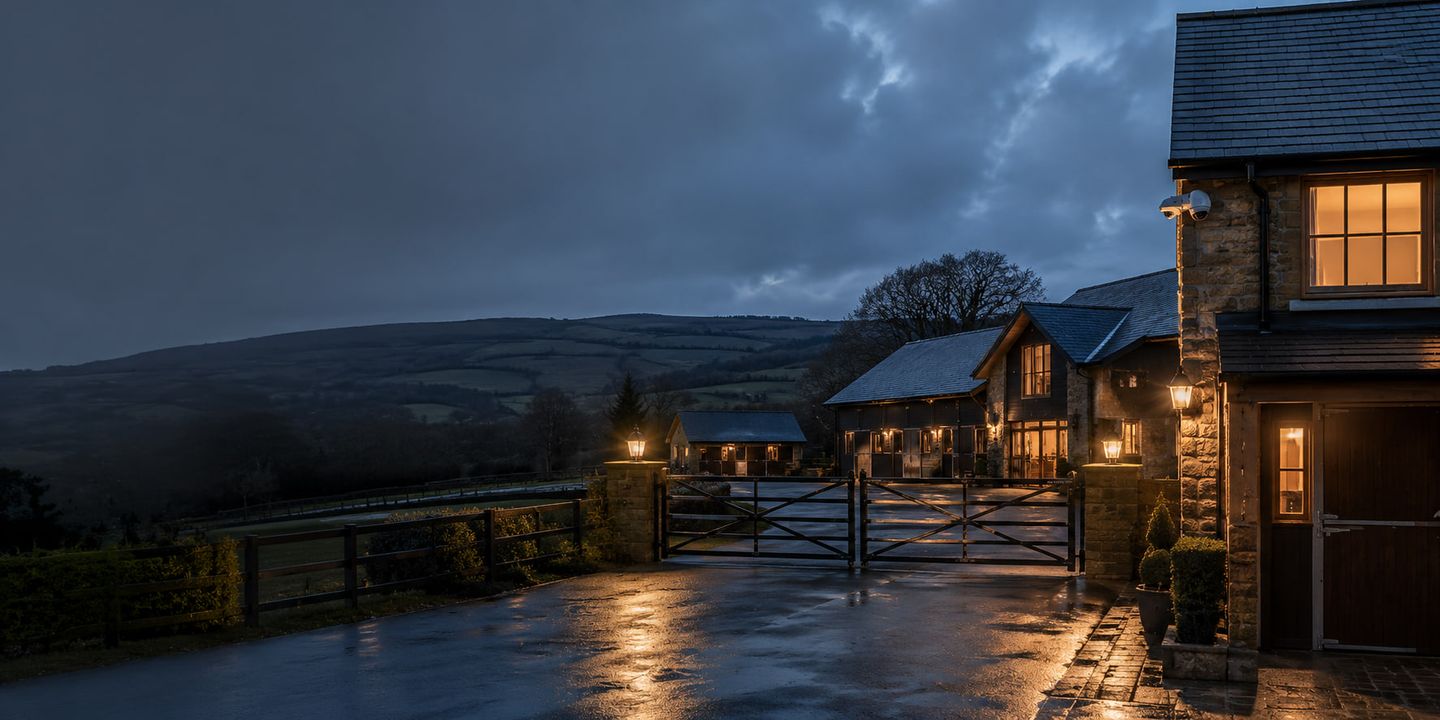
Access control
Access control and gates
On a rural site the question is almost never how to keep people out. It is how to let the right fifteen people in at odd hours without a key living under a water trough.
Access on a yard or a farm is a people problem before it is an equipment problem. So the survey starts by listing everyone who has a legitimate reason to arrive, how often, at what hours, and how much of the site each of them actually needs to reach.
That list usually shortens the specification. Plenty of sites need one controlled entrance, an intercom, and locking on two internal doors. Very few need every building on a card system.
Start with the people
Who comes through the gate in a normal week.
Liveries and yard clients
People who pay to be there, arrive at all hours, and change over. A fob you can cancel the day someone leaves is the whole point. Recutting keys for a yard of twenty every time somebody moves on is what makes people give up and leave the gate open.
Staff and grooms
Early starts and late finishes, often alone. Access that works at half past five in the dark, with lighting that comes on and an intercom that reaches somebody, is a lone working measure as much as a security one.
Vets, farriers and physios
They arrive when they arrive, sometimes urgently, and nobody wants a colic call waiting at a locked gate. Time-limited codes, an intercom to the house, or a fob issued to a regular professional all work. Which one depends on how often they come.
Deliveries and contractors
Feed, bedding, hauliers, the muck lorry, the fuel tanker. Most need to get to a specific part of the site and none need access to the whole of it. An intercom at the entrance and a record of when the gate opened covers most of this.
Everyone else
The point of a gate on a rural site is not that it stops a determined thief, because it will not. It is that arriving becomes a decision rather than a drift, and that anyone who does come in is on camera at the point they made it.
What that turns into on site
Automation on the gate you already have
Where an existing gate is sound, motors, safety edges and control can usually be added to it rather than replacing it. Swing and sliding gates both work; which is right depends on the fall of the ground and how much room there is to open into.
Locking on pedestrian gates and doors
Maglocks, strikes and keypads on tack rooms, feed stores, workshops and fuel compounds. Restricted areas inside a site are often more useful than a controlled entrance, because they limit what a person who is legitimately on site can reach.
Credentials that suit the people using them
Fobs, cards, codes or phone credentials. On a yard in winter with gloves on, a fob usually beats a keypad. On a site with a lot of one-off visitors, a code you can change beats issuing fobs.
Intercoms at the entrance
Audio or video, to the house or to a phone. On a long drive an intercom saves somebody walking down in the rain, and it means a delivery driver has a way of announcing themselves other than sounding the horn at six in the morning.
A record of who and when
Every use logged, so an incident can be placed against the gate opening either side of it. Combined with a camera on the entrance, that turns an approximate account into a specific one.
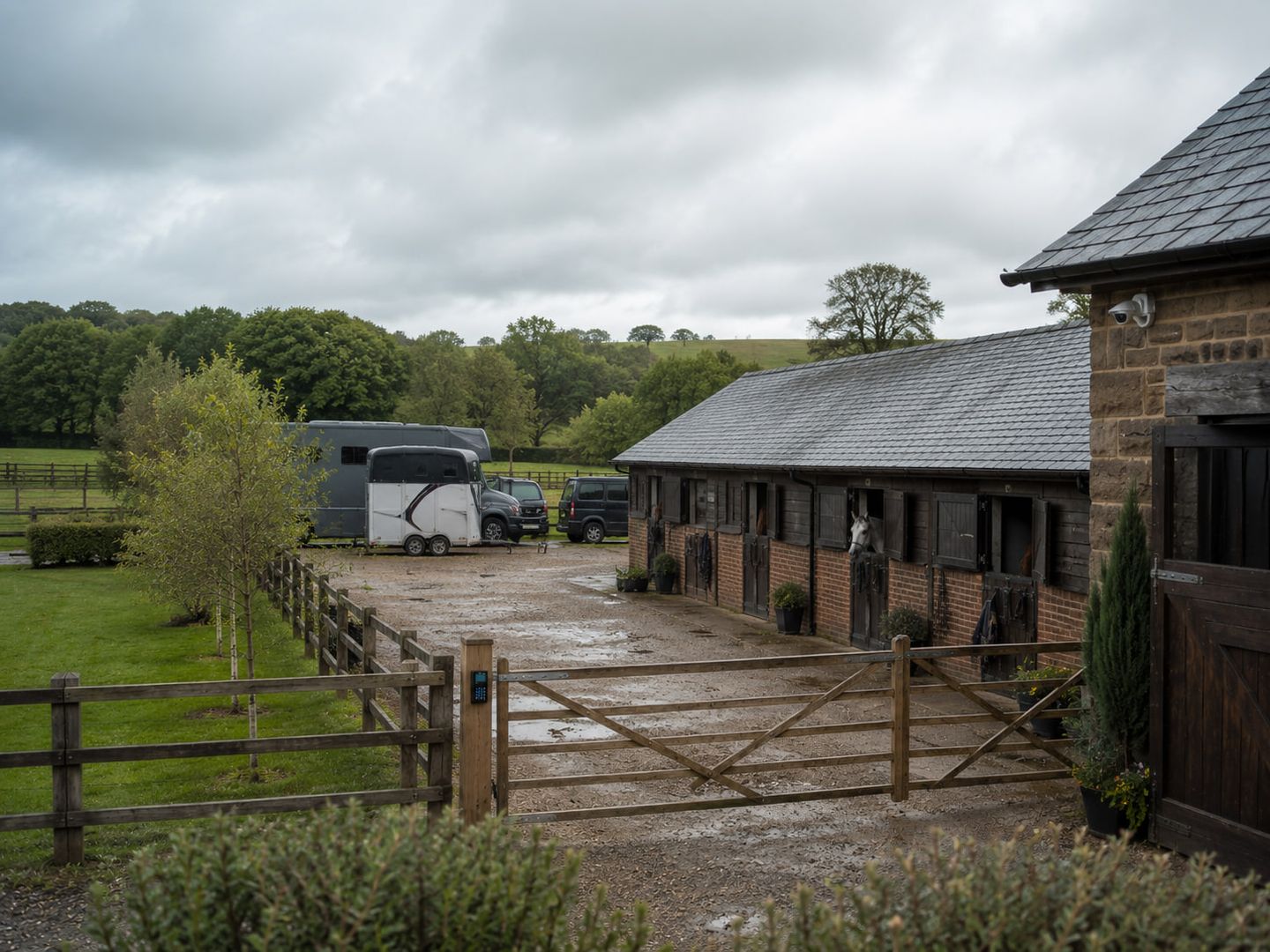
Twenty keyholders, no keys
The question on a rural site is almost never how to keep people out. It is how to let the right fifteen people in at six in the morning.
View livery yardsIn practice
Who needs to get in, and when.
Access is designed around the actual traffic on the site. Get that wrong and it is propped open within a fortnight.
On an equestrian yard
Fobs for liveries and staff, a code or intercom for the farrier, the vet and the feed merchant, and tack room locking controlled per person. When a livery leaves you cancel one fob instead of recutting every key on the yard.
View livery yardsOn a working farm
Automation on the gate that already exists rather than a replacement, sized for a tractor and trailer rather than a car. Free-exit for anything leaving, and an entrance that can be left open through silage and harvest without disabling the system.
View farm securityOn a rural estate
Separate credentials for the house, the estate yard, staff cottages and holiday lets, with intercom to the house from the main drive and a back drive that is closed by default rather than by memory.
View rural estates
Questions we get asked
Our gate is at the end of a long drive with no power. Can it still be automated?
Sometimes, with solar and battery, and sometimes not. It depends on gate weight, how many cycles a day it does and how much sun the position gets in December. We will do the arithmetic at survey rather than sell you a kit that works until the clocks change. See power and connectivity.
Can the gate open automatically for us but not for visitors?
Yes. Vehicle credentials, a fob in the cab or plate recognition can free-open for known vehicles while everyone else uses the intercom. Plate recognition needs a camera specified for it, which is the same specification as the identification camera you probably want at the entrance anyway.
What happens if the power fails while the gate is closed?
Automated gates have a manual release so you are never shut in or out. Where a gate is on an emergency route or a fire escape, the locking type and the fail state are specified deliberately rather than left to the default.
Are automated gates safe around horses and children?
They have to be. Powered gates are machinery under UK law and must be risk assessed, fitted with force limitation and safety edges or photocells, and tested. On a yard with loose horses, children and dogs about that is not paperwork, it is the reason nobody gets hurt.
We only want to secure the tack room, not the whole site.
That is a reasonable place to start and often the best value first step. A controlled door on the tack room plus detection inside it protects the concentration of value without changing how the rest of the yard works.
Related systems
What access control usually sits alongside
Most sites end up with two or three of these working together. Each has its own page.
CCTV
Cameras that read a number plate at the gate and a person at the barn door, in the dark, in the rain.
Intruder alarms
Detection zoned around tack rooms, workshops and fuel stores, set up so livestock and weather do not trip it.
Remote monitoring & connectivity
Getting a picture off a building with no broadband, and getting a response when something happens at 3am.
Fire detection
Early warning in stable blocks, hay and straw stores and workshops, where a fire is unsurvivable within minutes.
Servicing & maintenance
Lens cleaning, seal checks, battery replacement and signal tests, because rural kit weathers faster.
Next step
Work out who needs to get in, and when
Bring the list of everyone who arrives in a normal week. We will walk the entrance and the internal doors with you and specify the smallest system that actually solves it.