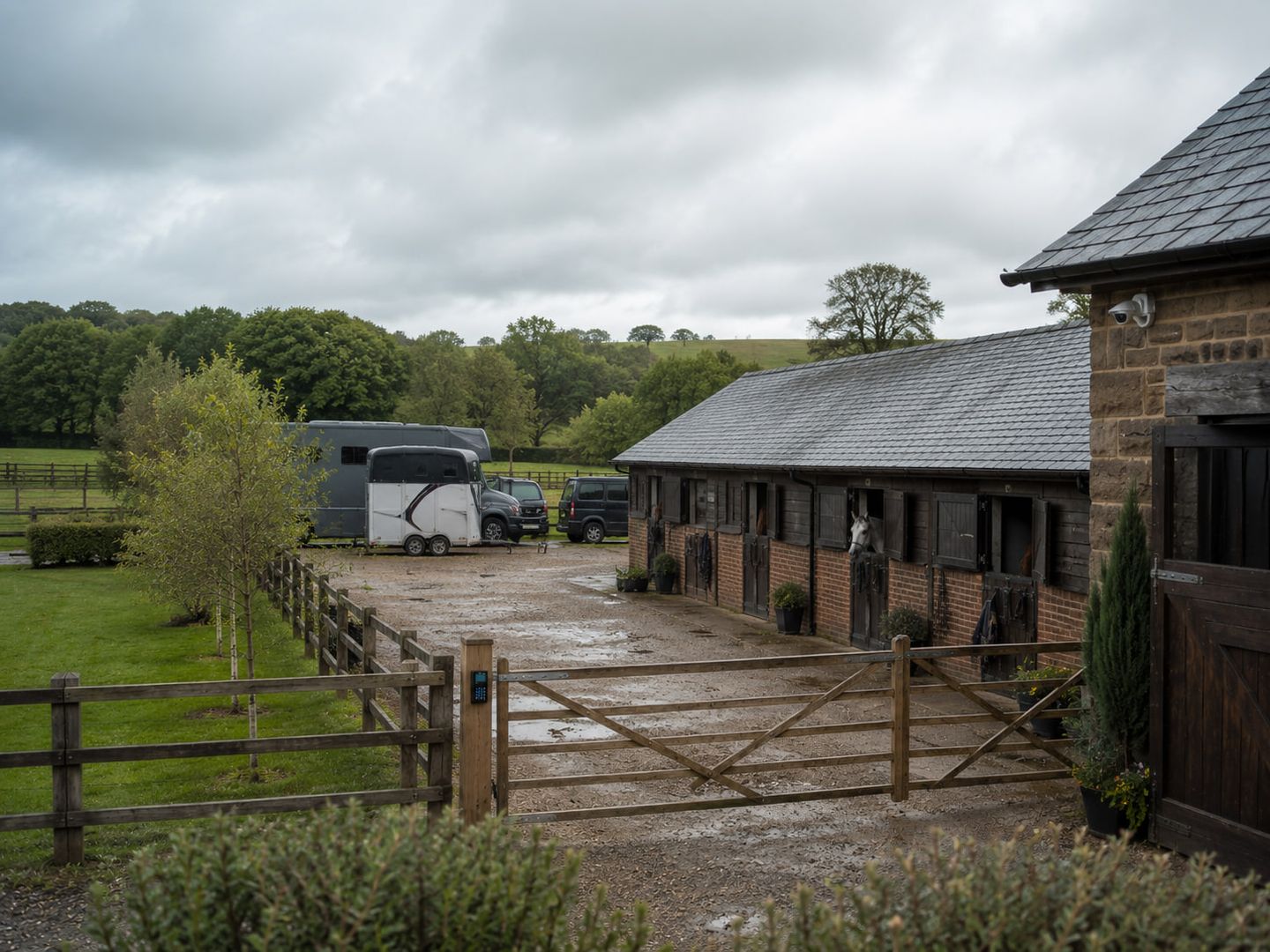
Equestrian security
Security systems for equestrian yards and stables
Yards do not fail on camera quality. They fail on the gate nobody watches, the tack room with a padlock, and the alarm somebody stopped arming after the third false activation.
A yard is a working site with public traffic, high-value portable property and nobody on it for most of the night. That combination is unusual, and it is why domestic equipment sold with a picture of a horse on the box tends not to survive contact with a real yard.
We survey the yard properly before specifying anything: where vehicles come in, where they turn, what the light does after dark, which buildings hold what, who has keys, and what has already happened here. The specification that comes back tells you what each camera is there to see and what the system deliberately does not cover.
The work is carried out by Secure Systems, an SSAIB certified security installer, which matters if your insurer has specified certificated installation.
What actually goes wrong
Five things that catch yards out.
The tack room is the target, and it is rarely near the house
Saddles, bridles, rugs and bits belonging to a dozen different people sit in one building, often the oldest one on the yard, with a hasp and a padlock. Tack accounts for a large share of equine theft claims and it is quick to move. A tack room needs detection inside it, not just a camera looking at the door.
The lorry park is a car park with no attendant
Trailers and horseboxes make up the majority of equine theft claims, and most are taken from somewhere other than the owner’s home address. A hitch lock is a delay, not a deterrent. What changes the odds is a camera that captures the towing vehicle and its plate on the way in.
Everyone has a legitimate reason to be there
Liveries, the farrier, the vet, the physio, the feed merchant, the muck lorry, a lorry driver picking up at five in the morning. A yard cannot be locked down like a warehouse, so the answer is knowing who came and when, rather than trying to keep people out.
The person on site is often alone
Early mornings, late evenings and lone working are normal on a yard. Security that also covers staff safety, a working intercom at the gate and lighting that comes on where someone is walking, is worth more than another camera on the barn.
Horses set off badly specified detection
A beam across a barn aisle will be broken by a horse looking over a door. External detection reacts to blowing rugs and swinging haynets. Zoning and sensor choice are what stop a yard system from being switched off within a month.
What we specify for a yard
In rough order of what buys you the most protection per pound spent.
The entrance, before anything else
One well-specified camera at the gate that reads a number plate at night, in rain, at the speed a vehicle actually enters, is worth more than four cameras looking at empty stables. It is the first thing we specify and it is usually the first thing we fit.
The tack room, the feed store and the lorry park
Detection inside the buildings that hold value, with signalling that reaches a phone. Where there is a lorry park, a camera positioned for the hitch and the plate rather than a general view of the yard.
Yard and barn coverage that works after dark
Cameras chosen for the light that is actually there, which on most yards is none. That means specifying illumination and lens together, and being honest about what a camera will and will not read at forty metres in the dark.
Foaling and welfare cameras where you want them
Cameras in foaling boxes and isolation boxes so you can watch a mare from the house instead of walking down at two-hourly intervals. It is the same infrastructure as the security system, which is usually why it makes sense to plan both at once.
Access you can change in a minute
Fobs or codes for liveries and staff, so a leaver is removed without recutting keys, and a record of who opened the gate and when. Gate control that lets a vet or a delivery in without someone walking down the drive.
The kinds of yard we work on
- Livery yardsMany keyholders, public access, shared tack rooms and no one on site after 8pm.
- Stud & competition yardsHigh-value horses, foaling watch, biosecurity and lorries loaded overnight before a show.
- Rural estates & country propertyLong boundaries, multiple dwellings, holiday lets, staff cottages and an unmanned back drive.
- Farms with horses on themWhere the yard is one part of a working farm with machinery, fuel and stock to think about as well.
Questions we get asked
Can I watch the yard from my phone?
Yes, and on most yards that is the point. Remote viewing is set up over the site’s own connection where there is one worth using, and over 4G where there is not. We configure it for the people who should have it, rather than leaving a default password on a recorder facing the internet.
We have no broadband at the yard. Is that a problem?
It is common and it is workable. Depending on what the survey finds, that is either a 4G router with the aerial in the right place, or a wireless link from a building that does have a connection. We check the actual signal at the buildings during the survey rather than trusting a coverage map. See remote monitoring and connectivity.
Will an alarm keep going off because of the horses?
It will if it is specified badly. Detection is zoned so that buildings holding value are protected while areas with animals and movement are handled differently or left out. If a system cries wolf, people stop arming it, which is the worst outcome of all.
Does this satisfy my insurer?
Insurers vary, and some specify that intruder alarm work is carried out by an SSAIB or NSI certificated company. Every system is installed by Secure Systems, which is SSAIB certified. Send us the wording your insurer has given you before the survey and we will tell you plainly whether we can meet it.
Can you work with what we already have?
Often, yes. If there is serviceable cabling, a usable recorder or a panel worth keeping, we would rather reuse it and spend the budget where the gaps are. We will tell you when something genuinely is not worth keeping.
Related systems
Systems we fit on equestrian sites
Most sites end up with two or three of these working together. Each has its own page.
CCTV
Cameras that read a number plate at the gate and a person at the barn door, in the dark, in the rain.
Intruder alarms
Detection zoned around tack rooms, workshops and fuel stores, set up so livestock and weather do not trip it.
Access control & gates
Entry that survives twenty liveries, a farrier, a vet and a feed delivery, without a key under the water trough.
Remote monitoring & connectivity
Getting a picture off a building with no broadband, and getting a response when something happens at 3am.
Fire detection
Early warning in stable blocks, hay and straw stores and workshops, where a fire is unsurvivable within minutes.
Servicing & maintenance
Lens cleaning, seal checks, battery replacement and signal tests, because rural kit weathers faster.
Next step
Book a survey of your yard
An engineer walks the yard with you, checks what the site can actually carry, and writes up a specification and a price. No charge, and no equipment list until someone has stood in the yard.